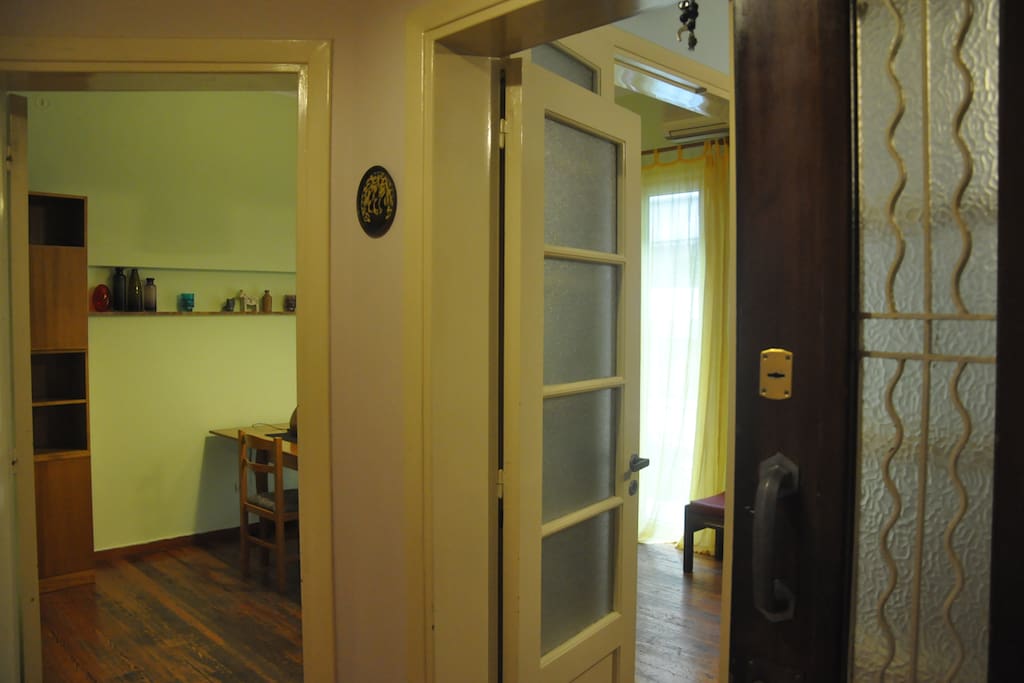
Bohemian modernist flat downtown

Zografou, Greece
Laid-back, colorful, modernist 60 sq.m. flat downtown. Feels as if you're staying at an absent friend's place. A variety of day- and night-life options accessible even on foot. Easy to commute, dir...
Showing posts with label Training Videos. Show all posts

Wednesday, 5 June 2013

Dynamo Concepts Training Videos: Biomechanical Training - Russian Stick Twirling

After the few Cossack dancing patterns we presented in this previous post in the Dynamo blog, it's time to take a look at another method of training biomechanics, i.e. quality of movement, in Russian Martial Art and namely, stick or saber twirling. 

Once again I would like to point out here that it is practically impossible to practice biomechanics and tactical skills in the same training drills. What you need to do is cultivate good quality of movement and the ability to generate power in non-tactical drills and then develop tactical awareness in another, totally different series of drills.

And herein lies the ingeniousness of folk-style Russian Martial Art: the biomechanics were taken care off through a series of training methods with a high social and entertainment factor! By learning to dance, young men practiced powerful pelvic and hip rotation, both components of tremendous importance in power generation. Then, by practicing stick or saber twirling, core stability, coordination and relaxation of the arms was developed, resulting in pure ballistic movement. This means that, when the time came for youngsters to study actual fighting methods, their body would not presents constraints in the learning process.

Enough with the talking: this is a short video presenting only a few stick twirling patterns that you could try out. Now, I only used baseball bats in the video, because I had just moved back to Greece from Sweden and my stuff was in boxes in a storage facility, so I could not find where my sticks were! This means that you should first try the exercises with something lighter, say a pair of sticks made of oak. 

How do you practice these drills? Well, make sure to have fun and don't go all OCD, counting reps, sets and rest intervals. You should literally fool around with the patterns and make sure that you can execute them slow and relaxed before you add speed and power, or else the momentum of the stick might rip apart your wrists or shoulders. Take it easy, and enjoy the process. You should expect a dramatic imporvement in your fist fighting skills after a few months of this type of training. PM me if you have any questions.


Train smart, train safe, be your own instructor,

Spyro

Tuesday, 23 April 2013

Dynamo Concepts Training Videos: Biomechanical Training - A Few Cossack Dancing Patterns

One of the most common problems in martial arts training arises when one is trying to mix up biomechanics of power generation with tactical skills acquisition in the same drill. In my almost thirty years in martial arts training I have witnessed more than a few times instructors trying to embed good biomechanical habits in their students (with comments such as "swivel those hips!" or "exhale sharp!") while they are sparring under live conditions. Well, let me - once again - be the bearer of bad news: training biomechanics and tactics in the same drill is impossible! If one has not learned to extend the back hip when punching, it is not a good time to learn it when he is being punched back!

Now, what I love about Russian Martial Art, or to be more precise, the folkstyle aspect of RMA, is the availability of numerous non-tactical drills that the practitioner can use to develop solid biomechanics of power generation, separately from the drills with tactical or technical content. I have only seen similar biomechanical drills in Chinese 'internal martial arts', and especially BaGua, but the difference here is that RMA drills are also fun to practice: for those of you who do not understand what I mean, I suggest you try some Russian stick or sword twirling or maybe some Cossack dancing patterns and then 'walk the circle' BaGua-style and tell me which is more enjoyable to practice.

In the two videos I'm posting today you will find a few Cossack dancing drills. The point of those is to teach the practitioner to coordinate pelvic rotation with hip rotation, in order to improve foortwork, punching power and kicking power. For most people in martial arts the expressions 'turn from the hip' and 'rotate the pelvis' are considered to describe one and the same movement (god knows why). Well, these are two separate movements that, if coordinated, can tremendously enhance your ability to express power.

I certainly hope these videos will be of value to you, make sure you let me know if you have any questions. In our next blog post we'll present a few stick twirling drills.


Train smart, train safe, be your own instructor,

Spyro 

Thursday, 28 February 2013

Dynamo Concepts Training Videos: How to Breathe for Performance, Practice Drills

In the previous Dynamo blog post, we explained the two roles our breath plays during an activity that requires power generation for a significant amount of time. A friend who read the post inquired about drills one can use in order to prime the 'body as bellows' type of breathing, and that is what the Dynamo Concepts training video I am posting today is all about. I learned a great number of these 'vibration drills' from A.I. Retuinskih, founder of the ROSS system, and I came up with a few of my own variations down the road, for more sport-specific applications. The ones you will find in the following video are the most basic and the most important ones. You can practice them as part of your warm-up before any type of training, to elevate your heart rate and lubricate your elbow and shoulder joints before more strenuous activities, but also as part of your cool-down routine, to relax both your muscles and your nervous system. Besides embedding the 'body as bellows' type of breathing to your body, the drills will also help you relax your arm muscles and develop 'heavy hands' for strikes.

One last thing: through the following drills I hope you get to see that the funny huffing and puffing that passes as 'burst breathing' in some Russian Martial Art circles is just a defective version of the body as bellows principle: your breathing has to be coordinated with your movement so as to ensure it corresponds to both the physiological and biomechanical needs of your activity - otherwise, it will just get you hyperventilating, tense and panicky in no time.

I hope the video is of help to you. Please let me know if there is anything I could explain further.


Train smart, train safe, be your own instructor,

Spyro 

Wednesday, 20 February 2013

Dynamo Concepts Training Videos: How to Breathe for Performance

I don't know why, but way too many people in martial arts circles project mystical properties on breathing. And people who want to take advantage of other people make sure that confusion is perpetuated and as widely spread as possible - in a few words, ignorance sells seminars.
I hate to be a party pooper, but breathing is just a physiological process, that helps provide energy for the activities involved in... well, life. Now, if an activity demands lots of energy, breathing performs one more role, namely that of delaying the onset of muscular fatigue: you breathe faster, thus you exhale more often, so you remove the excess carbon dioxide from your blood, so you slow down the acidification of your muscles - no biggie there either. Let's take this one step further: if your activity involves generating significant amounts of power or absorbing significant amounts of force, then your breathing acquires one more role, this time a biomechanical one, that of stabilizing your core, in order for your limbs to have a stable platform to generate power from.  - simple as ABC!

In case you did not notice, in both cases above, physiology AND biomechanics, it is your exhalation playing all the important parts: removing excess carbon dioxide AND stabilizing your core. So, the basic idea behind the performance breathing method we use in the Dynamo Concepts system is to emphasize exhalation and the rest will take care of itself. I was first taught this method of breathing by A.I. Retuinskih, founder of the ROSS system. Down the road, through personal communication with Dr Vladimir Tikhonov, a sports scientist working with the Russian kettlebell sport national team, I found out that this the exact same way elite kettlebells athletes breathe during the later, most fatiguing stages of their sets.

In the following video I am explaining this method of breathing that, in the ROSS system, is known as 'using the body as bellows' and I am using the kettlebell snatch lift in order to demonstrate one type of application. Besides my work with kettlebells, I have applied this breathing technique with my students during bag and focus mitts work and have found out that it helps keep the heart rate significantly lower during intense effort exercise.

Go ahead and check the video, then, and If there's anything I could further explain, just send me a message. Please keep in mind that my breathing in the video is a bit more pronounced so that it can be audible - you definitely don't have to breathe so loud, but you sure need to coordinate your breathing with the rhythm of your movement.


Train smart, train safe, be your own instructor,

Spyro

Monday, 4 February 2013

Dynamo Concepts Training Videos: Long Power, Short Power, whatever...

Well,  I am embarrassed to admit that this is my first post for 2013. To my defense I have to say this has not been out of laziness, but because I have a number of training projects currently going on, so my brain is somehow always occupied...

Enough said - today's Dynamo Concepts Training video is a sequel to the previous one on punching power and, at the same time, an answer to a question a couple of friends of this blog posted some time ago: "If I am to recruit my joints consecutively, I need a lot of space in order to the distal part of my kinetic chain to develop maximal speed. What if I have to use 'short power'?" Honestly, I believe the term 'short power' does not exist (it could be something used for a nonsensical title of one of those useless Systema RMA instructional DVDs). Whether you have to generate long-range or short-range power, your body does not have two types of muscles, one for each type of power, and definitely doesn't generate power in 'different modes'. The only thing you can do is limit the degrees of freedom around a joint, by creating rigidness through muscular tension (once again, 'tension' is not necessarily a bad thing) - basically, you remove one or more links of the chain, so the movement ark becomes shorter - and the end result is, of course, less speed than if you could use all joints consecutively, but still, maximum speed and power under given circumstances.

Check out the following video to see a couple of examples. If there's anything I could further explain, just send me a message.


Train smart, train safe, be your own instructor,

Spyro

 
P.S.: Once again, I apologise for the quality of sound :-)

Monday, 24 December 2012

Dynamo Concepts Training Videos: A Tip to Significantly Increase Your Punching Power

With this blog post being 'the one before Christmas', I just wanted to share a small gift with the readers of this blog, and, given that we're into martial arts, I suspect that a gift that will improve one's punching power will be appreciated by most :-)

Anyway, this video is all about maintaining rigidity at the wrist, so that the object I am striking an opponent with is the forearm-fist complex, which has significant mass. By making sure that, when striking with the fist, there is no movement at the wrist (limiting the degrees of freedom at the wrist, if you prefer), we limit the amount of kinetic energy that would otherwise be dissipated in our own soft tissues (and very delicate ones, since there are many things in one's wrist that can get very screwed up).

From a teaching perspective, it is quite often not enough to state that the wrist should be rigid, since a lot of students have never practiced this action, so their local muscles and nervous system are in no way primed to do this. The drill which is demonstrated in the video does exactly this: with the help of a partner the exact muscles needed to limit degrees of freedom at the wrist are activated. I suggest you go ahead and practice this drill a few times before you strike the focus mitts of the heavy bag. I guarantee you will be surprised by the results!

That's all for now, folks! I hope you find this video of help. Make sure you send me a message in case there is something I can explain in more depth.

Merry Christmas and/or Happy Holidays to you, your families and loved ones!

Spyro

P.S.: Once again I apologise for the sound quality of the video. When you're filming in the garden you cannot quite know when the alarm of a neighboring house will go off. Still, you have to admit that an image of summer in Greece can be quite heart-warming in the middle of the winter.


Thursday, 13 December 2012

Dynamo Concepts Training Videos - Interlude: The Spinal Wave and Drills

In this fourth part of our series of Dynamo Concepts instructional videos, we're dealing with a power generation 'plug-in', the spinal wave. By plug-in, I mean that the wave of the spine can be added to any of the three basic movement patterns, in order to further enhance power output. There is nothing exceptional in the spinal wave - it is just one more application of kinetic linking which is one of the five principles of maximizing power, that we have described in part 2 of this series of videos. I should point out here that, if this movement seems to you large and telegraphic, it is only performed this way in training, not in application. A very important guideline in the Dynamo Concepts is that we train in full range of motion and we apply in the range of motion necessary. A big movement can be trimmed down to a short one, by restricting degrees of freedom. On the other side, if one only trains short and tight, it is not possible to perform longer movements by adding degrees of freedom that are not available in the body.

I believe you will find the drills included in these spinal wave videos very effective in increasing your power output potential - in my personal experience, the kettlebell jerk is the best of them, since additional resistance can be added, by using heavier and heavier bells.

I hope you find this video of help. Make sure you send me a message in case there is something I can explain in more depth.
Train smart, train safe, be your own instructor,

Spyro


Wednesday, 5 December 2012

Dynamo Concepts Training Videos, Part 3: Generating Power in 3-dimensional Space

This is the third in the series of Dynamo Concepts training videos, dealing with generating power to all directions from a static position, including the basic drills for priming basic movement patterns. Any action we perform should be powered by either one or a combination of these movement patterns, otherwise it will be lacking power. Another idea that emanates from these movements is the rhythm of power generation: since we can generate power by loading and unloading our structure in specific ways, our ability to apply force depends upon which part of 'the beat' we find ourselves. We will have the opportunity to elaborate on the subject of rhythm later in the series.

The first two of these movements I have been taught by Alexander Ivanovich Retuinskih, founder of the ROSS system and I believe it is worth noting that he also uses these exact same movement patterns for a series breath training exercises, aiming to improve integration of movement and breathing.

I hope you find this video of help. Make sure you send me a message in case there is something I can explain in more depth.

Train smart, train safe, be your own instructor,

Spyro 


P.S.: The drills might remind you stuff you have seen in traditional Chinese martial arts. Please keep in mind that power generation is not a cultural issue :-)

Wednesday, 21 November 2012

Dynamo Concepts Training Videos, Part 2: Five Principles of Maximizing Power

Here's the second from the series of videos I have promised to post on this blog, this time with the Dynamo Concepts system's five principles of maximizing power. This is plain sport science here, people, stuff that good boxing coaches (track and field coaches too) have known for years.

In a nutshell, these principles are:
1. Ballistic movement: 'casting' the limbs
2. Kinetic linking: recruiting my joints consecutively, from proximal to distal, timing recruitment in such a way that the movement at a distal joint is created at the exact moment that maximum speed of movement has been developed at the nearest proximal joint.
3. Continuous movement: preserving momentum of the moving limbs, flowing from one direction to another.
4. Stored elastic energy: using connective tissues (both parallel and serial elastic compnents of the muscle-tendon complex) as rubber bands that stretch and spring back into their resting length, adding an additional force component to that of muscular contraction.
5. Rotational movement imparts additional kinetic energy to the moving limbs and involves more muscle groups in each movement.

I hope you find this video of help. Make sure you send me a message in case there is something I can explain in more depth.

Train smart, train safe, be your own instructor,

Spyro


Thursday, 15 November 2012

Dynamo Concepts Training Videos, Part 1: System Structure

So, it's been a while now that I've been somehow quiet through this blog, since many changes have happened in my life this year and frankly, there hasn't been enough time to think and ponder upon training ideas. On the other side, within the past few months I have taken some time to film a number of training videos, in order to help some friends who live far away to put some of their martial knowledge into perspective, so that they can make their training more substantial and productive. After giving it some thought and discussing it with a few close friends, I decided to make these videos available to everybody, through this blog. In any case, it is my belief that the knowledge I'm trying to convey through the videos has been out there and available to everybody all the time, as long as they took the time to think themselves instead of hiring a master to 'reveal' it to them. 

Anyway, I hope you enjoy the videos and make sure you drop a line in case I can explain something better. Please keep in mind that these are home videos and sometimes the quality leaves a lot to be desired - can't control background noise, can you?

This first video I am posting today is about the Dynamo Concepts system structure: Use your body in the most efficient way, affect the opponent's body in the most effective way, develop tactics and use them according to your strategy - that simple!

Train smart, train safe, be your own instructor,

Spyro